Preventing Hive Robbing and Managing Defensive Behavior During Nectar Dearth Periods
This post contains affiliate links. As an Amazon Associate, I earn from qualifying purchases at no extra cost to you.
Nectar dearth arrives quietly. One week your bees return loaded with clover pollen and goldenrod nectar; the next the landing board is a war zone: guards fighting in a seething knot, dead bees piling up in the grass, a frantic hovering cloud of strangers probing every crack in your hive body. That’s robbing, and if you don’t intervene within the hour, a strong neighboring colony can strip your hive’s stores completely before sundown.
In most of North America, late summer through early fall is the highest-risk window. The main flow has ended, forage is scarce, and every colony in your neighborhood is running the same calculation: steal food rather than search for it. Defensive behavior spikes alongside robbing pressure, and the two problems amplify each other in ways that consistently catch new beekeepers off guard. The preventive measures here are low-cost and high-return. Act before the problem starts - the beekeepers who navigate dearth season well are the ones who do.
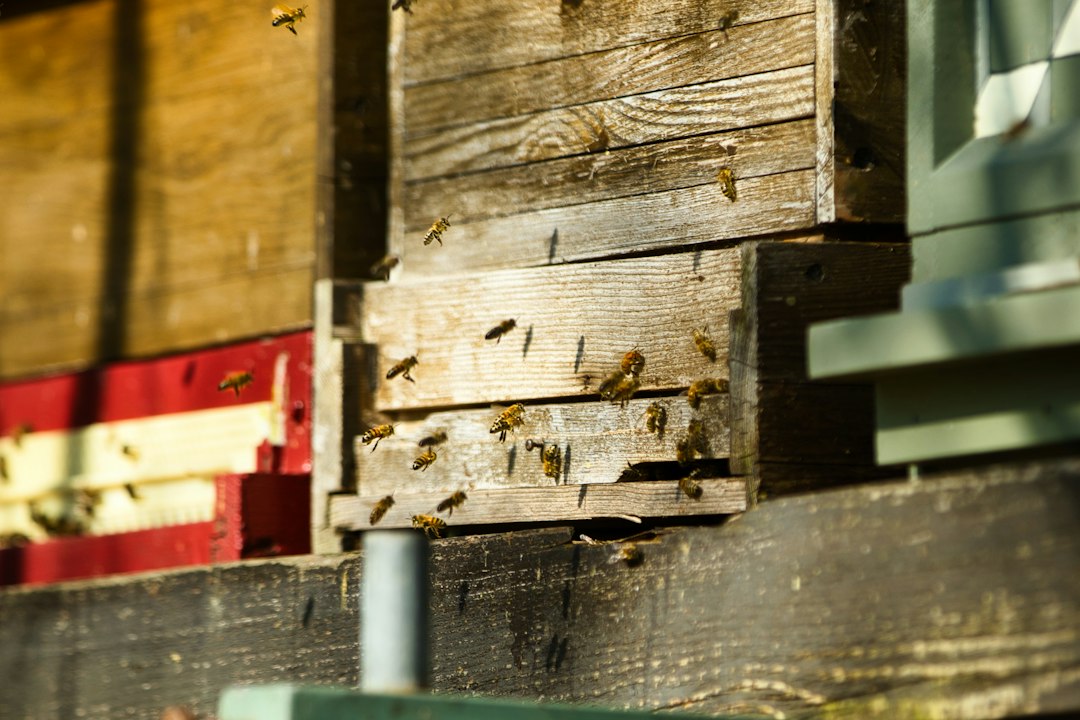
Photo by 𝕡𝕒𝕨𝕤 𝕒𝕟𝕕 𝕡𝕣𝕚𝕟𝕥𝕤 on Unsplash
What Is Hive Robbing and Why Nectar Dearth Triggers It
Honey bees are opportunistic foragers. When natural nectar sources dry up, scout bees shift their search toward any accessible sugar source, including stored honey inside neighboring hives. Robber bees enter a target hive, fight or slip past the guards, and carry out honey by the load. A sustained robbing event can collapse the targeted colony within 24 to 48 hours.
Nectar dearth is the primary trigger. In most of the eastern United States, late summer (July through September) is the main dearth period, though this varies considerably by region and annual weather. Florida beekeepers face a distinct summer dearth separate from their fall one; Upper Midwest keepers may see a gap between clover and goldenrod flows. The trigger is not the calendar - it is local flora. Your bees know before you do. When forager traffic slows noticeably but guard activity at the entrance increases, dearth has likely arrived.
Secondary conditions that worsen robbing risk include:
- Weak colonies with small guard populations that cannot cover the entrance
- Large hive entrances that defenders cannot adequately control
- Open syrup feeding placed outside the hive body
- Hive inspections during dearth that release honey odors into the surrounding air
- Spilled honey, wet frames, or wax cappings left anywhere in the apiary
Robbing risk also scales with strength imbalance in your yard. A yard of similarly sized colonies carries lower overall risk than one where a large, established colony sits adjacent to a small nuc or a first-year hive. According to Penn State Extension’s beekeeping resources, colonies with fewer than four frames of bees are particularly vulnerable because guard populations are insufficient to mount a meaningful defense against a determined aggressor colony.
Robber bees approach a target hive in erratic, zigzagging or sideways-hovering patterns, probing cracks, joints, and the hive body perimeter while looking for any way in. Normal foragers fly in and out on a direct trajectory. Robbing involves visible fighting at the entrance, bees wrestling and tumbling to the ground in combat balls. Once you have seen it, you will not confuse it with orientation flights or normal heavy foraging traffic.
Recognizing the Signs of Hive Robbing in Progress
Speed matters. Catching a robbing event in the first 30 minutes versus responding an hour in determines whether the targeted colony keeps its stores. Learn both the early warning signs and the indicators of a full-scale event.
Early warning signs:
- Bees hovering and circling at the hive entrance rather than landing and entering directly
- Guards in unusually large numbers, actively grappling with arriving bees
- Combat balls of bees tumbling on the ground in front of the entrance
- Bees attempting to enter through cracks in the hive body or cover board
- Heightened agitation across multiple hives in your apiary simultaneously
Indicators that full robbing is underway:
- Bees streaming into and out of the target hive in a chaotic, directionless mass
- Dead bees accumulating on the bottom board and in the grass in front of the hive
- A strong honey smell at the entrance, as bees drop honey in the frenzy
- The target colony’s own forager traffic drops sharply while entrance chaos simultaneously increases
A useful diagnostic: watch the bees leaving the target hive. During robbing, they will be unusually heavy and sluggish, laden with stolen honey. The robbers entering are agitated and relentless.
Do not confuse robbing with a wasp or yellowjacket attack, which produces visually similar chaos at the entrance. Wasps are visually distinct in shape, and their flight pattern is more deliberate and less frantic than robber bees. For a full breakdown of wasp and other predator threats alongside robbing risks, see Protecting Hives From Wasps, Hornets and Backyard Predators.
Preventing Hive Robbing During Nectar Dearth
Prevention is substantially more effective than intervention. By the time full-scale robbing is underway, your options are limited and the colony has likely already lost significant stores. These steps, taken at the first sign of dearth or ideally just before it begins, eliminate the conditions robbing requires.
Reduce Entrances Before Dearth Arrives
Entrance reduction is the single most effective preventive measure. A narrower entrance creates a choke point that a small number of guard bees can defend effectively. A colony of 20,000 bees can hold a 1-inch opening against virtually any robbing pressure; an 8-inch fully open entrance requires far more guard capacity than most late-summer colonies can spare.
The 5 Pack Beehive Entrance Reducer, 10 Frame Wooden Hive Door Reducer lets you scale the hive opening to match actual colony strength. A strong colony can manage a wider opening, while a weak or recently established colony should be restricted to a smaller one. A colony actively being robbed can have the entrance reduced to a minimal opening as an emergency measure without harming the resident bees.
Install reducers before you need them. At the first sign of the nectar flow tapering off, put the reducers in place across the apiary. Manipulating entrances during an active robbing event just releases additional honey odor and disrupts the defenders at the worst possible moment.
Eliminate Attractants from the Apiary
Honey smells travel. Wax cappings discarded in the yard, wet supers left outside after extraction, and uncapped honey frames sitting on a table are each a broadcast signal to robber scouts. Render or freeze cappings immediately after harvest. Store wet supers inside a building or return them to the hive after dark, well after forager flight has ended, then seal the entrance before dawn.
Avoid opening hives at mid-day during dearth. The combination of peak robber-scout activity in the surrounding area and the honey and wax odors released during an inspection creates ideal recruiting conditions. Inspections at dawn or in the early morning carry substantially lower risk: fewer foragers are flying from neighboring colonies, released odors disperse faster in cooler air, and your bees are calmer overall.
Feed Inside the Hive, Never Outside
Open feeders, pans of syrup left in the yard, or mason jars set out near the apiary during dearth are robbing accelerants that draw in colonies from across the neighborhood. The Mann Lake Entrance Feeder sits at the hive entrance, allowing resident bees to access syrup from inside while the entrance remains easier for guards to defend. This design helps address the shared-access problem and limits the odor that open feeding methods broadcast into the surrounding area.
How to Stop an Active Robbing Event
If robbing is already underway when you arrive at the apiary, work through these steps in order without skipping ahead:
-
Reduce the entrance immediately. Block everything except a single bee-width opening using the reducer, foam weatherstripping, or a handful of green grass pressed into the gap. This forces all defensive activity to a single point that even a reduced guard force can hold. Do not remove the reducer once the robbing stops; keep it in place for at least two full weeks.
-
Cover the hive with a wet towel or sheet. The wet fabric disrupts the pheromone trail and visual landmarks that robbers use to navigate back to the entrance. Resident bees can navigate out through the cloth after a short period of disorientation; robbers lose their target lock. Drape the fabric over the entire hive body down to the bottom board.
-
Move the robbed hive if at all possible. Even shifting it 10 to 15 feet from its stand breaks the attack, because robbers are programmed to return to the exact location they first found. The robbed colony’s own bees will reorient to the new position within a day; the robbers will return to an empty stand.
-
Identify the primary aggressor colony. In most backyard apiaries, one strong colony is driving the event. Watch where the heavily laden departing robbers fly to. Consider temporarily relocating that colony or splitting it to reduce its robbing drive.
-
Do not open any hive during an active event. Opening the hive releases a concentrated honey odor burst and removes the defensible entrance advantage the guards are relying on. Wait until dusk when flight activity drops to near zero before inspecting the robbed colony’s condition.
-
Assess losses and mite exposure after the event ends. Robbing events are a significant mite-transfer mechanism. Robber bees carry mites from the source colony into the target hive, and mites from the target can hitchhike outbound. A post-robbing mite wash should be treated as mandatory, not optional.
Feeding Colonies During Nectar Dearth Without Triggering Robbing
Colonies that are light on stores heading into fall need supplemental feeding, but careless feeding during dearth can turn a manageable situation into an apiary-wide crisis. The goal is to minimize odor, minimize entrance disruption, and choose feed formats that bees from outside the colony cannot easily access.
Syrup Feeding Precautions
Use 2:1 syrup (2 parts sugar to 1 part water by weight) in late summer and fall rather than the thinner 1:1 ratio used in spring. Heavier syrup requires less processing by the bees, stores more efficiently, and produces less attractive odor than thin sugar water. Feed at night when robbing pressure drops, and limit fill volume to what the colony can consume in 24 to 48 hours. The longer syrup sits in a feeder, the greater the odor accumulation at and around the hive entrance.
Solid Supplemental Feed as a Robbing-Safe Alternative
During active robbing pressure or when dearth is severe, switching to solid feed reduces the liquid odor that can attract robbers. Sweet B - Simple Bee Fondant - 10 lbs (Peppermint) is placed directly on the top bars inside the hive, accessible only to the resident colony. Fondant produces less entrance odor than liquid syrup and does not require opening the hive for each refilling, making it a clean supplemental feed option during dearth season. It is also commonly used as a winter emergency feed in cold climates where liquid syrup may not be suitable. As a dearth-season tool, fondant lets you support a colony that needs nutritional help without broadcasting a target signal to neighboring colonies.
Managing Defensive Behavior During Nectar Dearth
Robbing and heightened defensiveness are related but distinct problems. A colony under active robbing pressure becomes defensive toward everything in the apiary, including you. But dearth-season aggression also occurs in colonies that are not being directly robbed. Bees protecting a finite, irreplaceable food supply during resource scarcity have a clear evolutionary incentive to challenge any intrusion, and they act on it reliably.
The Honey Bee Health Coalition’s best practices documentation notes that dearth-related defensiveness is a normal colony response and does not indicate a queen problem or Africanized genetics unless the behavior is disproportionate and persists well outside the dearth window itself.
Practical strategies for managing dearth-season defensiveness:
- Time inspections carefully. Mid-morning on warm, sunny days when most foragers are out of the hive is the window least likely to produce a defensive response. Avoid inspections before 10 a.m., after 4 p.m., before rain, or on overcast days when more bees are inside and on alert.
- Use smoke generously and correctly. During dearth, bees are already sensitized. Apply smoke liberally before cracking the cover and again throughout the inspection. Cold, thin smoke is ineffective; you need warm, dense white smoke from a fully loaded, well-established fire in the smoker.
- Minimize inspection time. A focused 10-minute inspection checking brood pattern, queen sign, and food stores is far less provocative than an exploratory 30-minute frame-by-frame session that releases sustained odor and disrupts the colony repeatedly.
- Avoid scented products before working your bees. Floral colognes, scented hand lotion, and strongly scented sunscreen can all trigger defensive responses, particularly when colony sensory systems are sensitized by dearth conditions.
- Reassess hive placement. Hives in high-traffic areas that are perfectly manageable during a spring flow can become a serious neighborhood issue during dearth. If your flight corridor crosses a neighbor’s yard or a pet area, consider temporarily repositioning hives for the dearth period.
Recognizing the early warning signs your bee colony is in trouble can help you distinguish dearth-related defensiveness from a more serious underlying issue, such as a failing queen, high mite load, or disease pressure that has weakened colony cohesion and is producing erratic rather than organized defensive behavior.
Common Mistakes That Make Hive Robbing Worse
Even experienced beekeepers repeat these errors during dearth season. Most stem from applying spring and flow-season habits to a fundamentally different management environment.
Leaving entrances fully open after the flow ends. This is the most common and most consequential mistake. Many beekeepers install entrance reducers in spring for new packages and remove them as colonies build strength, then never go back. The wide-open entrance that worked fine during a strong nectar flow becomes indefensible during dearth. Install reducers before you need them - at the first sign of the flow tapering off, not after robbing has already started.
Inspecting at mid-day during dearth. Opening a hive at 1 p.m. in August releases honey and wax odors into the apiary at exactly the time robber scouts are most active and recruitment is fastest. Shift your inspections to early morning or early evening during dearth periods, and move efficiently through whatever you’re checking.
Using external or open feeders. Top-feeder lids slightly ajar, syrup in open pans, and open water sources with sugar added are all magnets for robbers. All supplemental feeding during dearth must be inside-the-hive feeding using properly fitting, non-leaking equipment. This is not negotiable during active dearth.
Leaving wet extraction equipment in the apiary. Wet supers, uncapping tanks, and extraction buckets left outside after harvest create powerful honey odor plumes that persist for hours. Robbing outbreaks frequently begin within the first 24 hours following harvest when equipment is left unsecured. Clean everything inside, or return wet supers to hives after dark with entrances tightly reduced, removing them before dawn.
Failing to combine or support weak colonies before dearth arrives. A two-frame colony going into dearth is a target, not a functioning independent unit. The practical decision is to combine it with a stronger neighbor using the newspaper method. Attempting to support it with supplemental feeding during an active dearth often does nothing more than supply food to the robbers.
Opening hives during an active robbing event. When robbing is in full swing, the instinct is to investigate, check the queen, and count frames to assess damage. Every time you open the hive during an active event, you release another burst of honey odor and disrupt the defenders. Reduce the entrance, cover the hive, and step back. The correct response is containment. Assessment comes at dusk, after the event ends.
Frequently Asked Questions
How do I know if my bees are robbing a neighbor’s hive or just orienting?
Orientation flights involve young bees performing arcing, expanding flights in front of their home hive while facing the entrance. The behavior is calm, localized to one hive, and involves only newly emerged bees testing their bearings. Robbing is chaotic and occurs at the target hive rather than the source colony’s location. Robber bees fight guards, probe cracks and joints, and fly in erratic hovering patterns while trying every possible entry point. Combat balls of bees rolling on the ground and a distinct honey smell from the target hive’s entrance are the clearest confirmation. If you’re uncertain, watch for three to five minutes - robbing escalates fast, while orientation flights do not.
Can a robbing event spread from one hive to my whole apiary?
Yes, and rapidly. Once robbers from a strong colony successfully breach a weak hive, they recruit additional foragers using the same directional recruitment dance used for natural nectar sources. Within a few hours, opportunistic theft can become an organized mass event involving a significant portion of the aggressor colony. If your apiary has multiple weak hives in close proximity to one or two strong ones, a single event can cascade into simultaneous attacks on every vulnerable unit in the yard. When you detect robbing at one hive, reduce entrances across the entire apiary immediately - not just at the hive under attack.
Is it safe to re-queen a defensive colony during dearth?
Re-queening during dearth carries higher failure risk than during a nectar flow. Colonies are defensive, inspections are more disruptive, and queen acceptance rates drop when colonies are under resource stress. More importantly, if the defensiveness is dearth-related, a new queen will not resolve it. Bees from any genetic background become more defensive when food security is threatened by environmental conditions. Wait until dearth conditions ease and forage resumes, then evaluate the colony’s temperament over several weeks of normal activity. If the colony remains excessively aggressive well outside dearth season, genetics may be the issue and re-queening is then the appropriate response.
How long does nectar dearth typically last?
Duration varies significantly by region, local plant communities, and annual weather patterns. In much of the eastern United States, the primary late-summer dearth runs six to ten weeks, typically mid-July through late September, after which fall goldenrod and asters may provide a modest late flow. Desert Southwest beekeepers often face more severe and extended dearth periods. Track your local bloom calendar over multiple seasons and use actual forager traffic as your real-time indicator. When foragers return consistently with pollen and colony behavior normalizes, dearth is easing. Rely on what your bees are doing, not what the calendar says.
Do entrance reducers stress the colony in summer heat?
This is a legitimate concern that depends on colony size and conditions. A very small entrance on a very large colony in extreme heat can restrict ventilation and increase the cooling workload on the bees. The practical approach is to use the smallest entrance that provides adequate defense without cutting off airflow. A screened bottom board improves ventilation independently of entrance opening size, making tight entrance reduction less problematic in summer heat. In sustained temperatures above 95 degrees Fahrenheit, watch for heavy bearding that signals overheating rather than normal evening clustering. If overheating is apparent, open the entrance one slot wider while keeping it well below the full-open position.
Conclusion
Nectar dearth is a predictable seasonal stress, and hive robbing is its most acute and destructive expression. The beekeepers who come through dearth with colonies intact are not lucky. They reduced entrances before the flow ended, switched to inside feeders, timed their inspections to minimize odor release, and recognized the early signs of robbing fast enough to act. None of that requires expensive equipment. An entrance reducer and an inside feeder are two of the highest-return items in your entire dearth-season toolkit. Start with those two changes, build the inspection habits around them, and your colonies will arrive at winter in strong condition with stores intact.
Bookmark this guide now and revisit it in midsummer before dearth pressure builds. The preventive steps here pay off most when you take them before the problem starts.
Related Reading: